
You need long-form articles that cite real sources, not vague summaries. Choosing between Agility Writer and Autoblogging.ai comes down to how each tool handles research depth, bulk output, and WordPress publishing before you commit budget.
This comparison breaks down Godlike Mode SERP analysis, LSI keyword extraction, 35+ language support, and pricing so you can see which platform fits your workflow. By the end, you will know exactly which tool to pick for research-driven long-form writing.
Quick Verdict: Agility Writer vs Autoblogging.ai for Research-Driven Long-Form Writing
If you need research-driven long-form content at scale, Autoblogging.ai's Godlike Mode and bulk generation give it the edge over Agility Writer for most SEO-focused teams. Its SERP competitor analysis and semantic SEO tools support deeper research-driven writing, while bulk creation of up to 500 articles and 35+ integrations make it easier to move from draft to published content. Agility Writer remains a capable alternative for smaller, one-off projects, but Autoblogging.ai's 4.9 rating and 40,000+ users reflect a stronger fit for teams that prioritize research depth and volume.
At a glance: how Autoblogging.ai compares to Agility Writer, Autoblogging.ai for Research-Driven Long-Form Writing on the features that matter most.
| Feature | Autoblogging.ai | Agility Writer | Autoblogging.ai for Research-Driven Long-Form Writing |
|---|---|---|---|
| Research-Driven Long-Form Writing | ✓ | ✓ | ✓ |
What Is Autoblogging.ai?
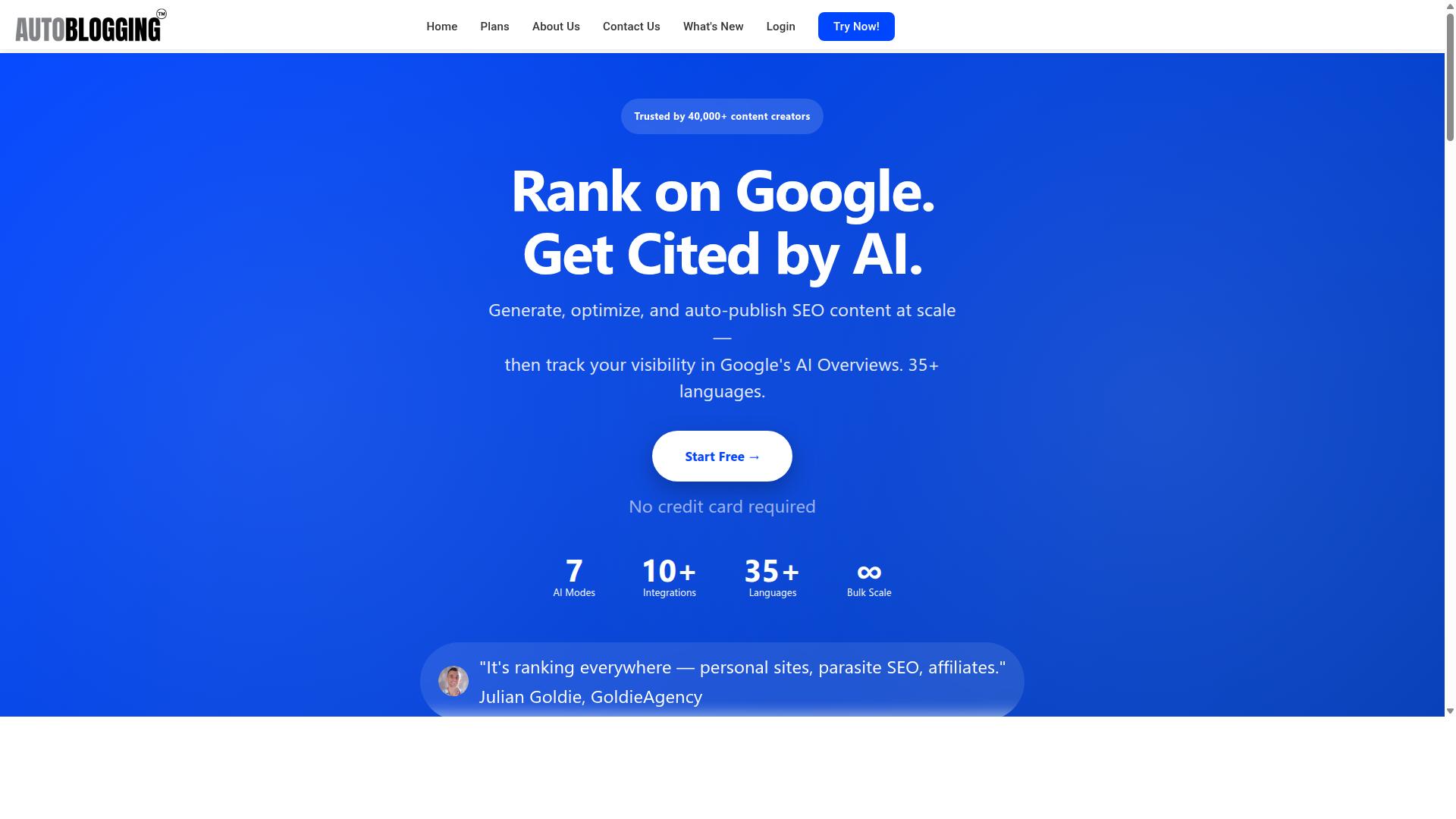
Autoblogging.ai is an AI-powered content generation platform developed by Digimetriq, designed to help bloggers, agencies, and SEO professionals produce high-quality articles efficiently. It is a SaaS product built for one clear purpose: taking the grind out of research-driven long-form writing so teams can publish more without scaling headcount.
The company behind it, Digimetriq, is the parent of Autoblogging.ai. Its stated mission is to help bloggers, website owners, and agencies save time and improve their online presence through cutting-edge technology. That focus shapes how the platform approaches automated blogging and SEO content at scale.
Adoption numbers tell a similar story. Autoblogging.ai is trusted by 40,000+ creators and has generated 1M+ articles, with a 4.9 rating from users.
Digimetriq's broader aim is to cut down content costs and give the power to human counterparts in standard operating procedures with the first draft. Longer term, the company intends to replace human counterparts entirely. In practice, that means Autoblogging.ai is positioned as an article writer that handles the heavy lifting of content generation, leaving people free to refine, review, and publish.
For readers weighing Agility Writer against Autoblogging.ai, the distinction matters. Both sit in the AI writing software category, but Autoblogging.ai's stated goal is narrower and more operational: reduce the cost and time of producing long-form content while supporting the humans who still guide the process.
What Is Agility Writer?
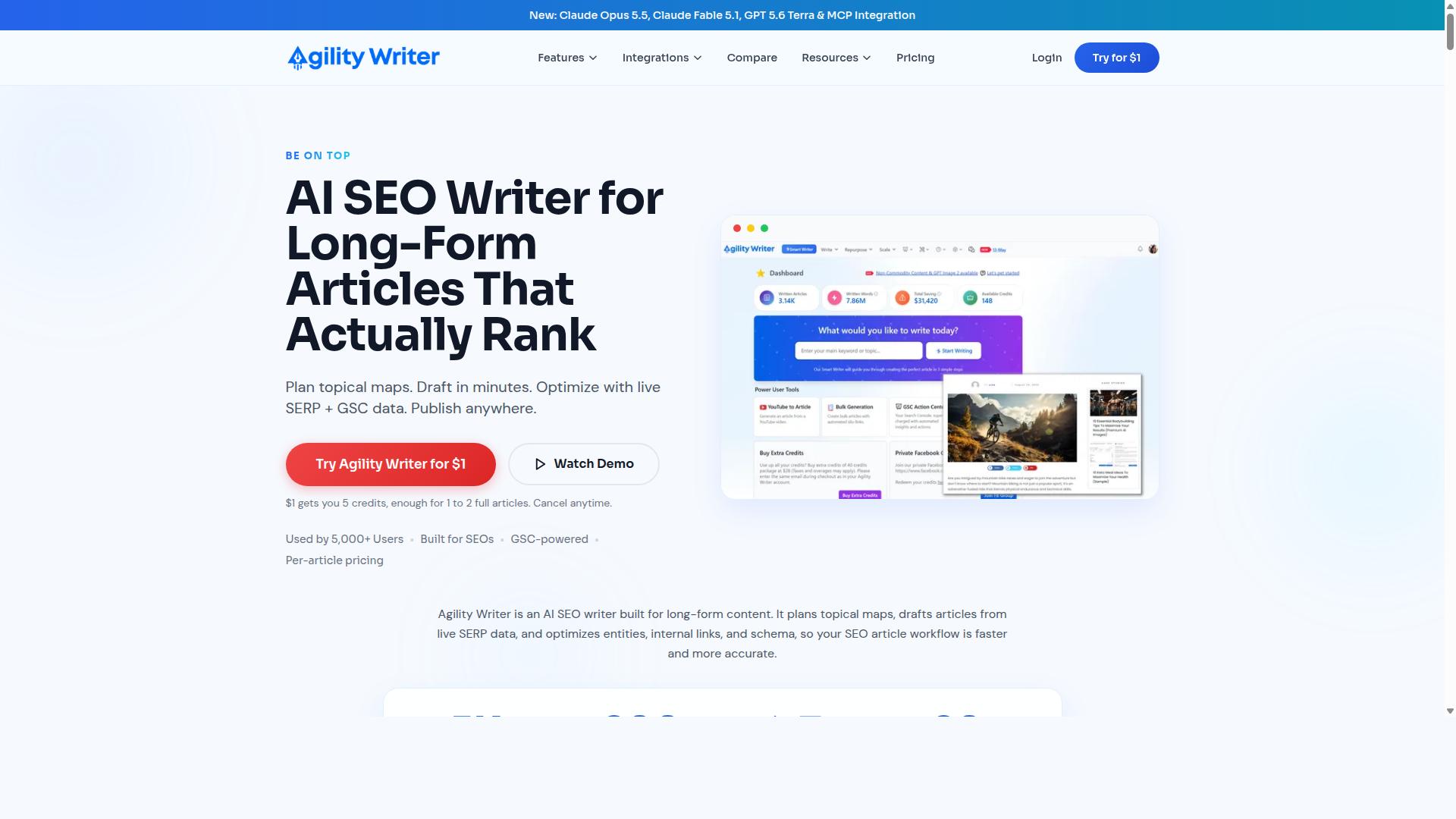
Agility Writer is an AI writing tool that focuses on generating long-form, research-backed content for SEO and content marketing. It sits in the same broad category as other AI writing software, competing for the attention of bloggers, agencies, and marketers who need to produce articles at scale.
What sets Agility Writer apart, at least in how it positions itself, is an emphasis on research-driven writing. Rather than relying purely on a language model's internal knowledge, the tool is generally described as pulling in external signals to inform the draft.
That approach matters because factual accuracy is one of the hardest problems in AI content generation. Large language models such as GPT-4 and GPT-3.5 can produce fluent prose, but they can also invent details. Tools that layer in research aim to reduce that risk.
Based on publicly available information, Agility Writer's workflow tends to revolve around a few recognizable stages:
- Gathering background material on a topic before drafting begins
- Generating an outline or content brief to structure the article
- Producing long-form output that targets a chosen keyword
- Offering editing controls for tone of voice and readability
These are common capabilities across the AI writing space rather than unique claims. Many tools now bundle outline generation, keyword optimization, and bulk content creation into a single interface.
Where Agility Writer is often discussed is in the context of depth of research. Writers who need citation sourcing, SERP analysis, or competitor research woven into the draft may find that emphasis appealing. The trade-off is that heavier research layers can add complexity to the workflow.
For anyone comparing options, the practical question is not whether Agility Writer can write, but whether its research features translate into articles that need less human editing before publishing. That is the standard against which any automated blogging or article writer tool should be judged.
What Is Autoblogging.ai for Research-Driven Long-Form Writing?
For research-driven long-form writing, Autoblogging.ai offers specialized modes like Godlike Mode that analyze SERP competitors, extract LSI keywords, and build knowledge graphs to produce in-depth articles. It is an AI article generation platform built around one core idea: that a strong long-form piece starts with strong research, not just fluent sentences.
That research-first approach is what separates it from tools that generate text from a single prompt. The platform gathers signals from the search landscape before drafting begins, which gives writers a factual and topical foundation for longer content.
Godlike Mode is the centerpiece for this kind of work. It performs SERP competitor analysis, so the article is shaped by what already ranks rather than guesswork. It also extracts LSI keywords to cover related terms and subtopics, and builds knowledge graphs that map entities and their relationships.
Together, these three capabilities support the depth that long-form content needs. Instead of thin coverage of a broad topic, the output can address the sub-questions and connected concepts that readers and search engines expect.
Autoblogging.ai also supports bulk generation of up to 500 articles via CSV and content in 35+ languages. For teams managing multiple sites or regions, that combination makes large-scale SEO content production practical rather than piecemeal.
The platform fits naturally into an SEO workflow. Supporting tools include Semantic SEO Analysis with a 21-point audit, a Snippet Optimizer, Topical Maps, and Fan Out Queries, all aimed at strengthening how content performs after it is written.
- Godlike Mode: SERP competitor analysis, LSI keyword extraction, and knowledge graph extraction
- Bulk Generation: up to 500 articles through CSV input
- Language coverage: 35+ languages
- SEO toolset: Semantic SEO Analysis (21-point audit), Snippet Optimizer, Topical Maps, Fan Out Queries
Publishing is handled through WordPress integration with unlimited sites, one-click posting, a plugin, and scheduled auto-posting. Content can also go to Web 2.0 platforms such as Medium, Dev.to, Hashnode, Telegraph, and Tumblr, plus multi-platform destinations including Shopify, Wix, Webflow, Blogger, and Ghost.
For research-driven long-form writing specifically, the value is in the front end of the process. Competitor research, keyword optimization, and entity mapping happen as part of generation, which reduces the manual groundwork that usually precedes a serious article. That makes Autoblogging.ai a strong fit for SEO content and automated blogging at scale.
Features Compared
When comparing Autoblogging.ai and Agility Writer, key differentiators emerge in research depth, long-form output capacity, and workflow support. Both platforms use AI to produce articles, and both target marketers who need consistent content output rather than one-off drafts.
The differences show up in how each tool handles research-driven writing and how much of the surrounding workflow it absorbs. Autoblogging.ai leans heavily into SERP analysis, semantic optimization, and publishing automation, while Agility Writer generally competes on template variety and editor flexibility.
For teams producing long-form SEO content at volume, the deciding factors tend to be research quality, scale limits, and how many manual steps sit between draft and publication. The three sections below break down those areas one by one.
Research Depth: Godlike Mode SERP Analysis, LSI Keywords & Knowledge Graph Extraction
Autoblogging.ai's Godlike Mode sets it apart by performing SERP competitor analysis, extracting LSI keywords, and building knowledge graphs to ensure comprehensive research. This happens before the draft is written, so the article starts from an understanding of what already ranks rather than a blank prompt.
The SERP competitor analysis examines top-ranking pages for a target query. From there, the system identifies LSI keywords, the related terms and phrases that signal topical relevance to search engines.
Knowledge graph extraction adds a third layer. It pulls entities and their relationships, which helps long-form content cover a subject with the breadth that ranking pages typically show.
Agility Writer also offers research-oriented features, and its approach may suit writers who prefer more manual control over the research stage. Specific capabilities vary, so checking current documentation is wise.
For research-driven long-form writing, the advantage of an integrated pipeline is consistency. When SERP analysis, keyword optimization, and entity coverage come from one system, content briefs and outline generation align with the same data from the start.
Autoblogging.ai pairs this with a 21-point semantic SEO audit and featured snippet optimization, so the research feeds directly into measurable on-page improvements. For SEO content where depth of research decides whether a page competes, that combination is the core strength.
Long-Form Output at Scale: Bulk Generation, 35+ Languages & One-Click WordPress Publish
Autoblogging.ai enables bulk generation of up to 500 articles in one go, supports 35+ languages, and offers one-click publishing to WordPress. For agencies and high-volume creators, those three capabilities remove most of the friction between planning and publishing.
Bulk generation runs through CSV input, which means a content calendar can be turned into drafts in a single pass. This is bulk content creation built for scale rather than one article at a time.
Language coverage matters for teams serving multiple markets. With 35+ languages, the same workflow applies whether the target audience reads English or another supported language.
Publishing is where the time savings compound. Autoblogging.ai supports:
- One-click WordPress publishing across unlimited sites, plus a plugin and scheduled auto-posting
- Web 2.0 platforms including Medium, Dev.to, Hashnode, Telegraph, and Tumblr
- Multi-platform publishing to Shopify, Wix, Webflow, Blogger, and Ghost
- API, Zapier, and n8n connections for custom pipelines
Agility Writer also produces long-form output, though its scale limits and publishing options may differ. Its strengths generally sit in the drafting and editing experience rather than end-to-end automation.
For a team managing dozens of sites, the combination of bulk generation and publishing automation is what separates a scalable operation from a manual one.
Workflow Support: Human Proofreader, 35+ Integrations & Weekly Feature Updates
Autoblogging.ai supports content workflows with a human proofreader, over 35 integrations, and weekly feature updates to keep pace with SEO trends. Each element targets a different bottleneck that slows content teams down.
The human proofreader is included in all plans, which matters for teams concerned about AI detection, factual accuracy, and readability. An AI Proofreader is also available for faster automated checks before human review.
Integrations connect the platform to the rest of a stack. Alongside WordPress, the options include Zapier, n8n, and API access, supporting content scheduling and custom publishing flows.
Weekly feature updates mean the tool evolves alongside search engine behavior. Credits rollover and 24/7 support round out the operational side, and the platform reports 40,000+ content creators, a 4.9 average rating, and 1M+ articles generated.
Agility Writer provides workflow features of its own, and its editor and template options are often cited as flexible. Exact integration counts and update cadences vary, so verify current details before committing.
The practical takeaway: Autoblogging.ai reduces manual effort across research, drafting, proofreading, and publishing, while Agility Writer tends to leave more of that orchestration to the user. For research-driven long-form writing at scale, fewer handoffs means faster output and more consistent quality.
Pricing Compared
Autoblogging.ai offers tiered monthly plans starting at $19 for 40 credits and scaling up to $999 for 5,000 credits, with annual discounts available. That entry point makes it easy to test the platform on real research-driven writing projects before committing to a larger plan.
Agility Writer takes a different route. It offers subscription plans with varying credit limits, and the exact cost depends on the tier and usage volume you choose. Because pricing structures like this can shift over time, check the vendor's current page for precise figures rather than relying on older comparisons.
Here is how the Autoblogging.ai tiers break down for monthly and annual billing:
| Plan | Monthly Price | Credits | Annual Price |
|---|---|---|---|
| Starter | $19 | 40 | $12/mo ($148/year) |
| Regular | $49 | 120 | $32/mo ($382/year) |
| Standard | $99 | 300 | $64/mo ($772/year) |
| Gold | $179 | 600 | $116/mo ($1,396/year) |
| Premium | $249 | 1,000 | $162/mo ($1,942/year) |
| Enterprise | $999 | 5,000 | $649/mo ($7,792/year) |
Two features stand out for anyone producing long-form content at volume. First, all plans include credits rollover, so unused credits carry forward instead of expiring at the end of a billing cycle. Second, Autoblogging.ai provides 24/7 support, which matters when a deadline is close and a draft needs attention.
New accounts also get 10 free credits per month with no credit card required, and additional credits can be purchased if a project runs long. Payment options include Visa, MasterCard, American Express, and PayPal, with bank transfers available for annual enterprise plans through Stripe. You can cancel anytime.
For teams that would rather skip the software entirely, Done For You packages are available: Starter at $1,200 for 1,000 articles, Pro at $1,600, Corp at $4,000, and Senpai at $10,000, each covering 1,000 articles.
On value for money, the comparison comes down to flexibility. A rollover credit system suits research-driven writing, where some articles need heavy SERP analysis and competitor research while others are straightforward. Agility Writer's credit-based subscriptions may work well for predictable workloads, but readers should weigh how each model handles uneven months. For most long-form workflows, Autoblogging.ai's combination of rollover credits, round-the-clock support, and a low-cost entry tier makes it the more forgiving choice.
Who Should Choose Autoblogging.ai
Autoblogging.ai is ideal for bloggers, SEO professionals, marketing agencies, and affiliate marketers who need to produce research-driven long-form content at scale. Its design centers on bulk content creation and automated blogging, which makes it a natural fit for anyone managing more than one site or client.
Where a tool like Agility Writer tends to suit writers who want a hands-on editing experience, Autoblogging.ai leans toward volume and workflow automation. That distinction shapes which audience gets the most value from each platform.
The following groups tend to benefit most from what Autoblogging.ai offers:
- Bloggers and content creators running personal sites or niche portfolios
- SEO professionals who need SEO content across multiple properties
- Marketing agencies producing articles for client websites
- Affiliate marketers building and scaling affiliate sites
- Website owners managing local sites or larger content portfolios
Each of these segments shares a common need: consistent output without losing the research foundation that makes long-form content rank. Autoblogging.ai addresses that with features such as Godlike Mode and a range of integrations that support publishing workflows.
Use cases map neatly onto these audiences. Parasite SEO campaigns, client websites, and portfolio sites all demand repeatable content generation at a pace that manual writing rarely matches. For agencies juggling several clients, the ability to produce research-driven long-form content in bulk is a practical advantage.
Affiliate marketers often run dozens of pages across a single site, and portfolio owners may operate several domains at once. Autoblogging.ai's bulk generation approach fits these scenarios better than a workflow built around one article at a time.
| User Type | Primary Need | Why Autoblogging.ai Fits |
|---|---|---|
| Bloggers | Consistent publishing | Bulk content creation for personal sites |
| SEO professionals | Scale across properties | SEO content generation with research-driven output |
| Agencies | Client deliverables | Supports client websites and portfolio sites |
| Affiliate marketers | High-volume site building | Fits affiliate sites and parasite SEO use cases |
For readers whose priority is producing long-form, research-driven articles across many pages or domains, Autoblogging.ai offers a workflow built for that scale. Its combination of bulk generation, Godlike Mode, and integrations makes it the stronger choice for volume-focused content operations.
Who Should Choose Agility Writer
Agility Writer may appeal to content creators who prioritize a streamlined interface and are focused on long-form research without needing bulk generation. That is a legitimate set of priorities, and it describes a real segment of the market. The question is whether that segment matches your own workflow.
If your output is measured in a handful of carefully crafted articles per month, a simpler tool can feel like enough. You write the brief, you review the draft, you polish it by hand. Volume is not the bottleneck, so automation depth matters less than a clean editing experience.
Agility Writer tends to suit users who want a single-article workflow rather than a publishing pipeline. The trade-off is that research, drafting, and publishing stay separate steps you manage yourself. For some writers, that control is the point. For others, it becomes the overhead they were trying to escape.
Consider Agility Writer if most of the following describe you:
- You publish a small number of articles and treat each one as a manual project.
- You prefer a simpler tool over a broader feature set, even if that means more manual steps.
- You handle publishing, scheduling, and site updates outside the writing tool.
- You are a solo writer or a very small team without a content calendar to fill.
- You want to stay closely involved in every draft rather than reviewing output at scale.
Where the comparison shifts is at scale. Research-driven long-form writing becomes a different problem when you need consistent output across many topics, keywords, and publishing dates. That is where automated blogging workflows built for bulk content creation tend to pull ahead of single-article tools.
Autoblogging.ai is positioned for that broader job: turning research-driven writing into a repeatable process rather than a one-off task. Readers who only need occasional long-form pieces may find a lighter tool sufficient. Readers who need steady, optimized output should weigh the two options with volume in mind.
| Priority | Agility Writer (general) | Autoblogging.ai |
|---|---|---|
| Primary use case | Individual long-form articles, handled one at a time | Research-driven long-form writing at scale |
| Workflow style | Simpler, more manual steps between research and publishing | Automated blogging workflow from research through publishing |
| Best fit | Solo writers and small teams with low output targets | Creators and teams who need consistent, optimized output |
| Publishing | Typically handled outside the tool | Publishing automation built into the process |
The honest takeaway is that Agility Writer fits a narrower use case: fewer articles, more hands-on editing, simpler tooling. If that is your situation, it may serve you well. If your goal is research-driven long-form content produced consistently, the stronger choice is the platform designed for that scale.
Who Should Choose Autoblogging.ai for Research-Driven Long-Form Writing
For research-driven long-form writing, Autoblogging.ai is the clear choice for teams that need deep SERP analysis, LSI keyword integration, and knowledge graph extraction. Those three capabilities sit at the center of what makes a long article rank, and they are built into the platform rather than bolted on as extras.
Agility Writer is a capable AI writing software option, and writers who only need occasional drafts may find it sufficient. But when the goal is a steady flow of SEO content grounded in competitor research and semantic depth, the comparison tilts toward Autoblogging.ai. The platform was designed for automated blogging at scale, not just one-off article generation.
Here is where Autoblogging.ai pulls ahead for this specific use case:
- Godlike Mode for the deepest level of research and output quality among its AI modes
- Bulk generation for producing many long-form pieces without rebuilding the workflow each time
- 35+ languages for teams publishing across multiple markets
- SERP competitor analysis and semantic SEO tools to inform content briefs and outline generation
- 21-point SEO audit and featured snippet optimization to tighten drafts before publishing
- One-click WordPress publish to move finished articles live quickly
The trust signals matter here too. Autoblogging.ai is trusted by 40,000+ content creators and holds a 4.9 average rating, with 1M+ articles generated on the platform. A human proofreader is included in all plans, which helps address factual accuracy and originality concerns that come with any large language model workflow.
Matching the Tool to the Writer
Autoblogging.ai fits best when research depth, volume, and publishing speed all matter at once. A solo blogger building topical authority, an agency running content for several clients, or an in-house team managing a busy editorial calendar will get more from a platform that handles SERP analysis, keyword optimization, and publishing in one place.
It also suits writers who value flexibility. Credits roll over, 35+ integrations are available, and new features ship weekly, so the tool grows with a content operation instead of capping it. 24/7 support adds a safety net for teams publishing on tight schedules.
Agility Writer remains a reasonable pick for someone who wants a straightforward article writer for lighter, less research-heavy assignments. For research-driven long-form content at scale, though, Autoblogging.ai combines the research layer, the SEO layer, and the publishing layer that this kind of work demands.
Final Verdict
After comparing features and pricing, Autoblogging.ai emerges as the stronger option for research-driven long-form writing due to its Godlike Mode, bulk generation, and extensive integrations. For writers who need depth of research, scale, and a workflow that carries a piece from idea to published post, that combination is hard to match.
Agility Writer remains a reasonable alternative for simpler needs. If your output is mostly short articles and you do not require heavy competitor research or bulk publishing, a lighter tool can get the job done. The gap opens up when long-form content and research-driven writing sit at the center of your strategy.
| Decision Factor | Autoblogging.ai | Agility Writer |
|---|---|---|
| Research depth | Godlike Mode for deeper research-driven writing | General research features, details vary |
| Scale | Bulk content creation for high-volume output | Better suited to smaller batches |
| Workflow support | Extensive integrations across the publishing pipeline | Some integrations, scope varies |
| Value | Broad capability set in one platform | Competitive for lighter use cases |
The reasoning behind the verdict comes down to four points:
- Research depth: Godlike Mode targets the kind of sourcing and depth that long-form SEO content demands.
- Scale: Bulk generation supports automated blogging programs where volume matters as much as quality.
- Workflow support: Extensive integrations reduce the manual steps between drafting and publishing.
- Value: One platform covering research, generation, and publishing is simpler to justify than stacking several narrow tools.
None of this means Agility Writer is a poor product. It is a viable choice for bloggers with modest output and straightforward topics. The honest trade-off is that simpler tools tend to show their limits once you need consistent factual accuracy, deeper SERP analysis, and repeatable output at volume.
For readers building a serious content operation, the recommendation is straightforward: start with Autoblogging.ai, run a small batch of long-form pieces through it, and judge the results against your own quality bar. If your needs are genuinely light, Agility Writer can still serve you well.
For further inquiries, you can reach Autoblogging.ai through the following channels:
- India: 501, Trinity Orion, Vesu, Surat - 395007, Gujarat, India
- Phone/WhatsApp: +91 84605-06553 / +91-8460506553
- Email: [email protected]
- Skype: vibes.yb
- Available 7:00-19:00 IST
- United Kingdom: 2nd Flr, SEO Content Suite, 35 Water Ln, Wilmslow, Cheshire SK9 5AR
- UK Phone: +44 1625 359056
- Social: Facebook, Twitter, LinkedIn
Frequently Asked Questions
What is the main difference between Agility Writer and Autoblogging.ai for long-form research-driven writing?
Both tools are built to help you produce long-form content faster, but they approach research differently. Autoblogging.ai offers 10+ AI modes, including Godlike Mode, which performs SERP competitor analysis, LSI keyword research, and knowledge graph extraction to ground articles in real search data. Agility Writer is also positioned as a research-focused writing tool, so the best choice depends on which research workflow and feature set fits your process.
How does Autoblogging.ai pricing compare to Agility Writer?
Autoblogging.ai starts with a free plan that includes 10 credits a month with no card required, then paid monthly plans run from Starter at $19 (40 credits) up to Enterprise at $999 (5,000 credits), with annual billing options available. Agility Writer offers a $1 trial (5 credits, enough for 1-2 full articles) and monthly plans starting at its Basic tier. Since plan structures and credit allowances differ, compare the tiers side by side against your expected monthly article volume.
Can Autoblogging.ai handle bulk long-form content production?
Yes. Autoblogging.ai includes a Bulk Generation mode that can produce up to 500 articles via CSV, which suits agencies and site owners managing multiple properties. Combined with 35+ integrations and credits that roll over, it's designed for sustained, high-volume publishing rather than one-off articles. Agility Writer also targets content production, so if bulk scale is your priority, check each tool's current limits before committing.
Which tool is better for SEO-driven research on competitive topics?
Autoblogging.ai's Godlike Mode was built specifically for this: it analyzes SERP competitors, extracts LSI keywords, and pulls knowledge graph data to inform the article. That makes it well suited to competitive niches where you need to understand what's already ranking. Agility Writer is likewise marketed around research-driven writing, so the practical answer is to trial both on a topic you know well and compare the output quality directly.
Does Autoblogging.ai support multiple languages and integrations?
Autoblogging.ai supports 35+ languages and 35+ integrations, so it can fit into a range of publishing stacks and international sites. It's trusted by 40,000+ content creators with a 4.9 average rating and 1M+ articles generated, and new features ship weekly. If your workflow depends on a specific integration or language, verify current support on the Autoblogging.ai site before deciding.
Is Autoblogging.ai suitable for beginners, or is it aimed at agencies?
It serves both. Beginners can start with Quick Mode, which is free and offers single and wizard options, while agencies and SEO professionals can use Godlike Mode, Bulk Generation, and News Mode for larger projects. The free plan with 10 monthly credits and no card makes it easy to test before upgrading. Autoblogging.ai is a product of Digimetriq.com, founded in 2022 by Vaibhav Sharda, and is available worldwide.
Recommended Resources: